Since 2018, this methodology has been embedded in the GK College BFA in Painting curriculum — the first instance in the Philippines of an original Filipino method becoming a formal academic subject.
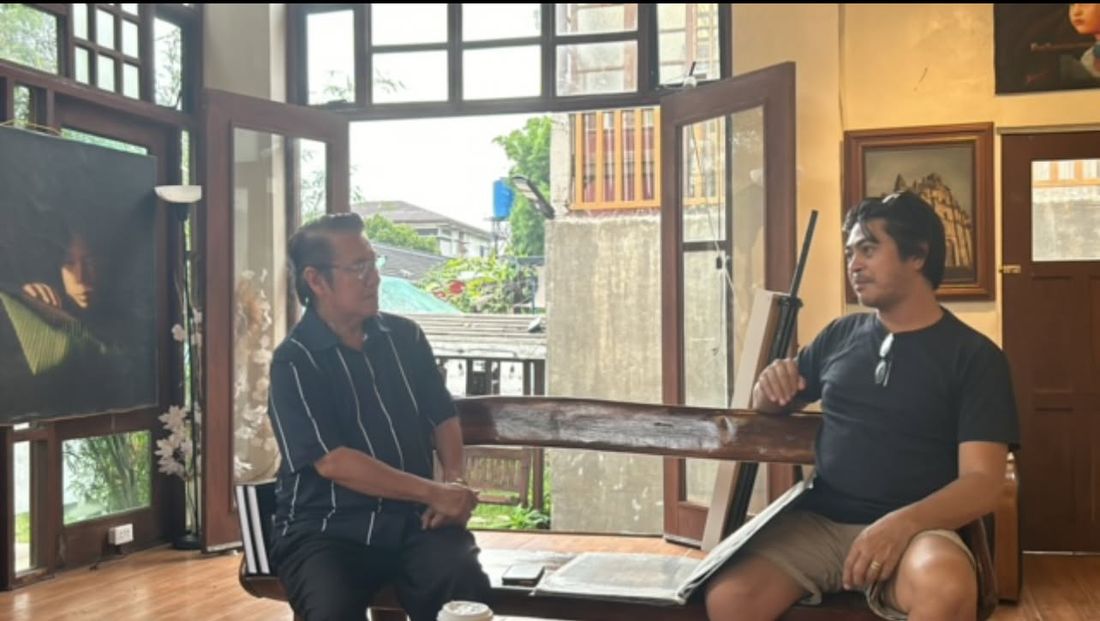
Among the most significant validations of Dr. Antiqueño's artistic philosophy is the sustained interest and engagement of Cid Reyes — the Philippines' foremost art critic, author of landmark volumes on Philippine art.
That Reyes would visit the studio and engage in extended conversation about Composed Photorealism is itself a critical endorsement of the deepest kind.
A photograph is a report on an interval — faithful to occurrence and unfaithful to almost everything else. What Dr. Antiqueño's method does is borrow the photograph's authority, its texture of having-been-witnessed, and detach it from the photograph's confinement to a single instant. The picture looks like a report on a moment. It is a report on a condition.
Consider what a person possesses when he says he remembers the afternoons of his childhood: not a series of dated afternoons, but something singular and composite — an afternoon that has absorbed many afternoons. This is not a failure of memory. It is what memory is for. Composed Photorealism is mimetic of memory rather than of appearance. It is realism at one remove: not a likeness of how things looked but a likeness of how they are retained.
The persistence of a single subject — the Filipino child, at play, in tropical light — over thirty-four years requires explanation, and sentiment is not one. Childhood in the provinces of the 1970s and 1980s was rarely photographed: cameras were scarce, film was expensive, and nobody photographs the ordinary while it is ordinary. The result is a body of experience universally remembered and almost entirely undocumented, passing out of memory as the generation that holds it ages. A method that reconstructs coherent scenes from surviving fragments is precisely the instrument this condition requires.
Photorealist rendering consumes weeks or months in which the painter does very little but look at his subject. To render a face at this level of fidelity is to spend an extraordinary quantity of time in the company of that face — a form of sustained attention difficult to distinguish from regard.
Dr. Antiqueño gives to a boy in a sando and rubber slippers the technical apparatus that the international photorealists reserved for chrome and plate glass. The choice of method is continuous with the choice of subject: both amount to the same proposition, that this deserves the attention normally given to that.
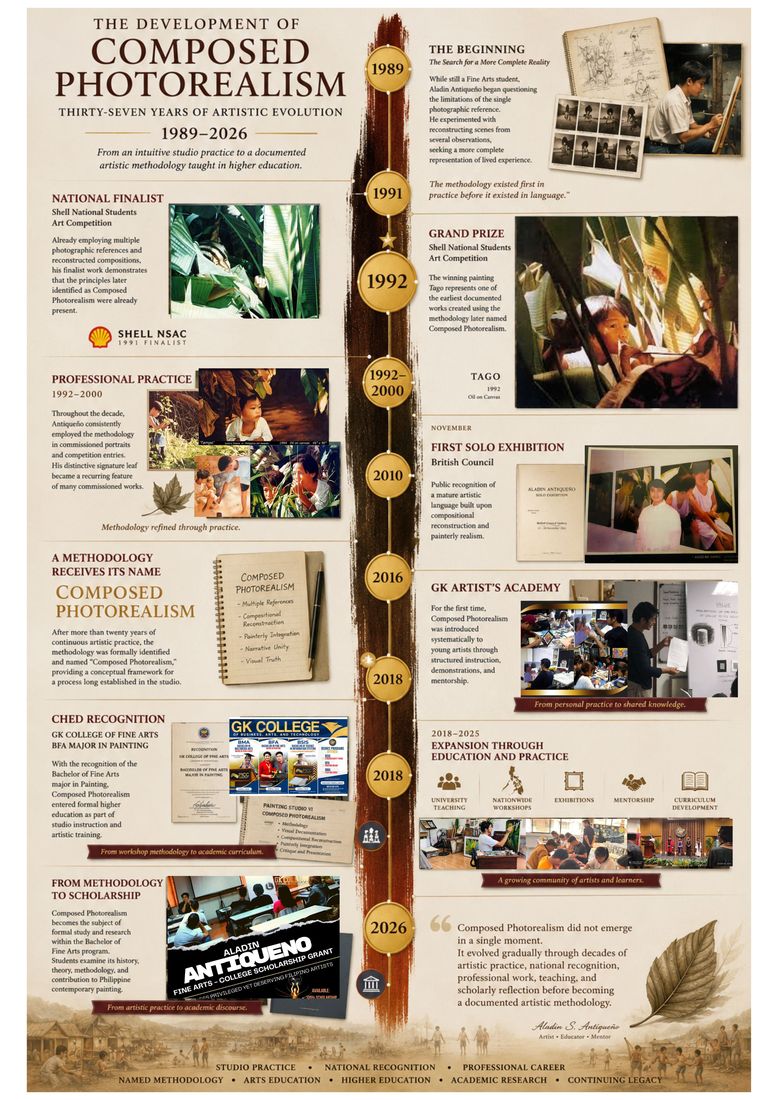
"An unnamed working habit belongs to one pair of hands and cannot be argued with, refused, taught, or improved, because there is nothing there to take hold of. A named method has been externalized — it can be examined, adopted, and rejected on stated grounds."
In 2010, the artist named the practice. Naming is the point at which a private solution becomes available to a culture.
This page condenses the scholarly chapter on Composed Photorealism. The full analysis — including its argument on artistic responsibility in an age of generative image systems — is reproduced in full in the Archive.