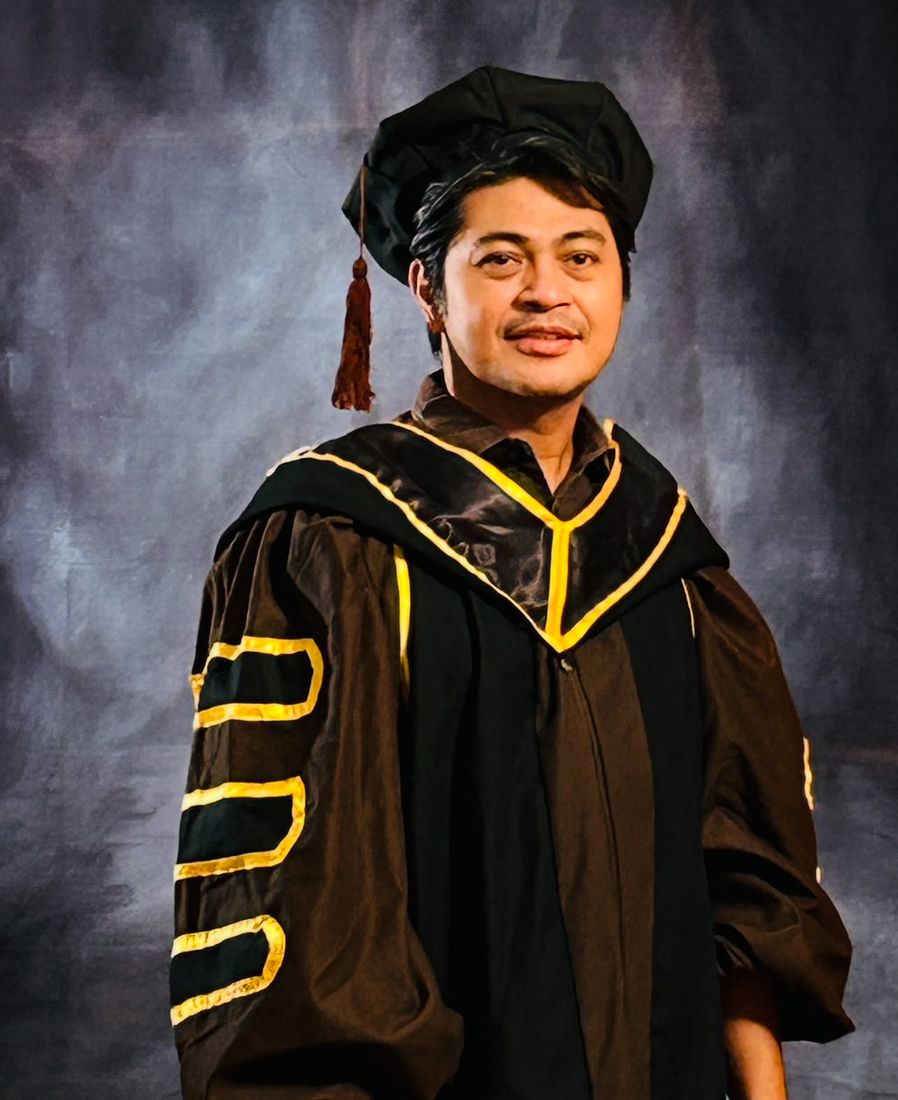
Aladen Antiqueño was born in Cainta on 22 November 1971, into a family whose lines run out of Manila in three directions — to Cadiz City in Negros Occidental, to Antique, and to Cebu. An artist whose family is dispersed across the Visayas does not grow up with a single, local idea of what Filipino life looks like; he grows up with the composite. Decades later he would build a method whose entire logic is composition — the gathering of separate places into one coherent image.
He was schooled in Cavite — Imus Pilot Elementary School, then Imus Institute — and has remained, in a Philippine art world organized almost entirely around Manila, a provincial artist by choice.
He holds a BFA from Philippine Women's University, an MA from World Citi Colleges, an earned Ed.D. from Greenville College (2024), and a DFA honoris causa from St. James, Pennsylvania (2023). As Dean of Fine Arts at GK College and President of UFAP, he leads the most significant arts education infrastructure built by any individual Filipino visual artist of his generation.
He is the originator of Composed Photorealism — formally named 2010, codified in four books, embedded in a CHED-accredited BFA curriculum since 2018.
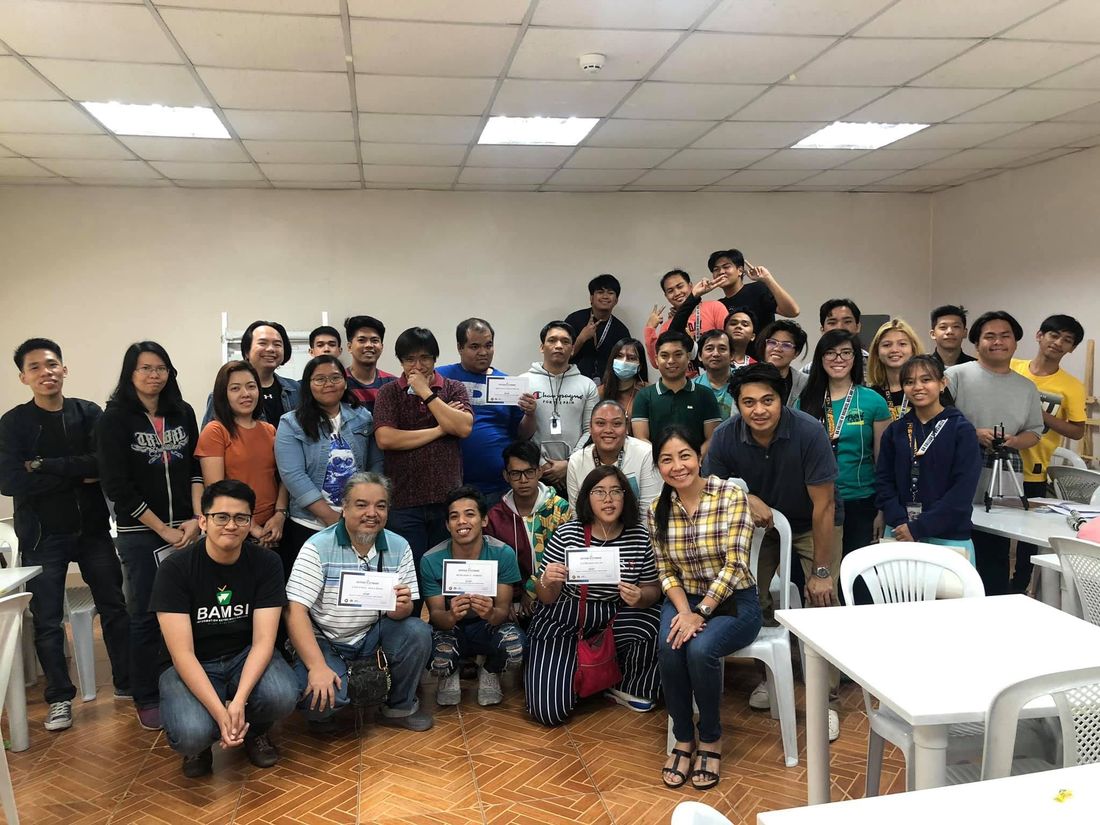
As President and founder of UFAP, Dr. Antiqueño has united visual artists across the archipelago under a shared commitment to artistic excellence, education, and cultural preservation.
Through UFAP he has organized exhibitions, workshops, scholarship programs, and cultural exchanges benefiting hundreds of artists across all career stages.
There is a particular kind of loss that Philippine culture has learned to expect. A master painter works for forty years, achieves a way of seeing that no one else has, and dies. The paintings survive; the way of seeing does not.
Aladen Antiqueño's life is a sustained refusal of that outcome. He watched himself photographing children in separate provinces on separate days and assembling them into single impossible afternoons, and he understood that this was not a habit but a method, with rules that could be stated. Then he named it, in 2010. Then he wrote it down. Then he built a school and put it in the curriculum — and a second school in Negros, and a gallery, and an academy, and a scholarship — so that it would exist in places he had never lived and among students he would never meet.
Philippine art will remember Aladen Antiqueño because he is one of a small number of Filipino artists who left behind something a stranger can pick up and use — a named method, written in books, taught in an accredited curriculum, carried by living practitioners.